|
|
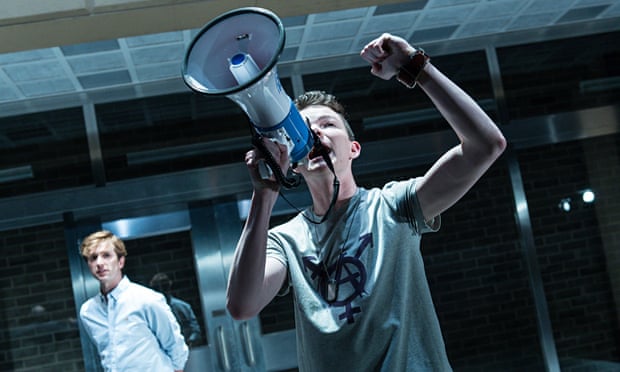
In the process of reverting the Old Vic from it's previous in the round space to the current proscenium arch theatre, someone seems to have destroyed the theatre. Where the lighting rig used to be, a horrible chandelier attempts to mask the cracks in the ceiling and the paint on the walls are peeling. The money spent on the unnecessary refurbished front of house should have been spent making this space habitable for an audience. Luckily, the production within it is far greater than the space inwhich it is being performed. Eugene O'Neill's masterpiece about the American class struggle and the need to belong is both touching and enraging in a good way. In what could easily be a counter-piece to the Great Gatsby, O'Neill explores the concept of self- fulfilling prophecy which is extremely prevalent in a poignant and a perfectly produced final scene. Richard Jones has staged this drama in a surrealist world, with a garish set and lighting design from Stewart Laing and Mimi Jordan Sherin that creates an intense and sweat-inducing atmosphere whilst the clever use of choreography from Aletta Collins effectively portrays the ritual beating down of the working classes represented in Yank which becomes more and more painful to watch. Bertie Carvel is a dominating and sad Yank whose need to belong in a world that makes no sense is heartbreaking. It is a masterful and award-worthy performance which captures the pain of words and a bruised masculine ego perfectly. An ensemble cast supports him well, especially the actor that appears in the final scene who creates a character that mirrors Carvel superbly. This is the Old Vic back to creating truly great theatre with yet another fantastic Richard Jones production.
Having never heard any Montiverdi before, I was taken aback by his
religious Vespers of 1610 at Milton Court. Loving Baroque music, I was
fascinated by the richness and complexity to his music. The soloists in
particular have music as difficult as any Rossinni opera. I Fagiolini
are a marvellously talented ensemble that take this task on well. With
the BBC Singers, the two groups are powerful at times, especially during
the Magnificat. However, at other times the music seems deadened and
lacks the beauty and tone that one would expect from a first-class
choir. St James's Baroque ensemble are splendid and have an elegance and
fluidity. The almost constant movement of the soloists to the balcony
and back felt messy and, for me, slightly took away from the sacred and
delicate aesthetic with no real effect on the music. Whilst the music is
at times explosive, it lacks a dynamic and engaging quality that all
concerts should have.
 |
|
Jonathan
Miller's production of the Rossinni classic comedy is almost 30 years
old. Now in it's twelfth revival, the traditional and simple staging is
looking dated. Unlike John Copley's Boheme, Tanya McCallin's design has
no real punch or artistic impact. There is nothing dynamic or alive
about the staging and is in dire need of revitalisation. And yet I left
the Coliseum with a firm smile on my face. From the overture to the
curtain call, Rossinni's music delights and entertains and, thanks to
Christopher Allen's colourful and emotive conducting, provides a
musically satisfying evening. This is helped by some extremely talented
singers. Anyone who can sing this opera deserves high praise and for
this group of singers to inject the energy they do is quite remarkable.
Morgan Pearse's Figaro is playful and fun whilst Eleazar Rodriguez is a
forlorn as the Count yet delivers hilarious accents whilst maintaining
top musical standards. It is a rather large step for the audience to
believe that he is the love of Lathryn Rudge's Rosina yet the magic of
opera let you believe it for the duration. Rudge, however, steals the
show. From Una voce poco fa, she gives a wit and a defiance to
Rosina along with an incredible tone of voice. This is helped by Amanda
and Anthony Holden's witty libretto which feels fresh and far from the
stuffy operatic text we have come to expect. Andrew Shore is also
notable as the antagonist Dr Bartolo whose fast tongue masters the
tricky and fast paced score. The cast and music shine here in a
production that needs to be put out of it's misery.
 |
|
The Maria, in my short experience, has always provided very alternative theatrical pieces and Jeff James' production of Margarite Dumas' play about a couple meeting up after their divorce is no different. La Musica is a very stereotypically French play. Even Barbara Bray's translation keeps the references and the contemplative tone. The first half sees Emily Barclay and Sam Troughton facing a window away from the audience with cameras capturing the smallest facial expression. This move is less grating than the video usage in Measure for Measure on the main stage and gives the audience a meaningful insight into these people's lives with a cinematic quality. The second sees the action relocated to an in the round setup with the audience moving to both sit and stand whilst the two actors sharing similar sentiments in a more dynamic way. However, at times the repetition bores and despite Ultz's extraordinary design Bray's translation of Dumas' play just isn't interesting enough. Barclay and Troughton try to breathe life into the text with a powerful and complex relationship which is wonderfully and fascinatingly staged by Jeff James yet I just couldn't get over the plodding and static text which disappoints, in spite of the first rate production values.
The emphasis of Dominic Cooke's production of Christopher Shinn's play about the issues facing the LGBTQ community post equal marriage is loneliness. You walk into Hildegard Bechtler's clinical and blank space with chairs positioned in a circle. However, the play does not start with a group conversation but with Gabe putting away the chairs, making the space empty and foreboding. All of the people in this play are lonely, whether it's because of their sexuality or their personality. The event that occurs at the end of the first half isn't really a tragedy but is what this community need; a call to arms and a chance to unite and not be lonely. The importance of symbols and the issue of mental health is discussed here with sensitivity and works rather well. Acting-wise, the American accents held up well for me but other audience members did complain. Luke Newberry and Oliver Johnston are fantastic as the core couple as Gabe and Drew whose new relationship, as with our sympathies for each of them, waxes and wanes throughout with secondary characters interfering, notably Kadiff Kirwan's Nicky, Nathan Wiley's Tim and Christopher Imbrosciano's Jay as well as Anjli Mohandra as Tim's girlfriend Jenny who all do well in providing layered characters and not just acting as plot devices. Matthew Marsh is a horribly familiar President who appears to behave like the politician we know and hate today, in holding a focus group to be seen to be doing something whilst in fact not doing anything. Pamela Nomvete and Griffyn Gilligan as Ellen and Jaq, along with Gabe and Jay are the diverse crew the President assembles and, whilst Gabe's ambitions cloud his judgements, the rest see through the President's illusion and fight back in a satisfying way. The hubris displayed by Newberry as Gabe is heartbreaking, with his final scene reducing me to tears and the lingering silence at the end reflects the thoughtful and haunting nature of this surprising and well thought through production.
 |
|
Mark Wrigglesworth has brought an astonishing and fresh production of Shostakovich's controversial opera that shows the full strength of their orchestra and chorus. Right from the start, I was blown away by the sheer force and scale of these wonderful resources as this 'muddle' transforms into wonderful music about love, lust and, in Dmitri Tcherniakov's production, the divide between East and West. The traditional Russian house with rugs lining the walls juxtaposes the modern Western style office layout of the factory in Tcherniakov's design and this difference resonates strongly and demonstrates Katerina's isolation in this strange and different setting. The sex is raw and strong without being indecent or offensive which is helped by having a strong and vocally able female protagonist in Patricia Racette. The role is tricky and she navigates around the part fantastically and is both brave and ambitious yet devoted and emotionally engaged. The contrast between Peter Hoare's weak and disheveled Zinovy contrasts greatly to John Daszak's Sergei who is ferocious and strong. Your opinion of him changes the most throughout the narrative in a very un-operatic nature. However, the chorus steal the show in the few moments where they sing collectively. They have a force that is as great as Mastersingers and provide wonderful atmosphere. Whilst the music can occasionally be straining, this almost perfect musical rendition of Shostakovich's opera is a fantastic start to a promising new regime at the ENO.
 |
|
The final production of the Ameida's Greek season brings Kate Fleetwood as the vengeful Medea in Rupert Goold's strikingly modern production with Rachel Cusk's reimagining of Euripides' tragedy as the story of the divorce between two successful writers has an unrelentingly feminist message whilst, in the process, discussing the destructive nature of divorce and the emotional damage it can bring to children in the middle of it. The notable thing about this production is the change of ending. If you are coming for horror, blood and gore, you will be disappointed. No screams or any graphic scenes are constructed, with a clinical production and design from Ian Macneil. Any production of Medea hinges on the quality of the titular character and Kate Fleetwood is a worthy Medea. She is angry and vengeful in the role yet also containing love and sanity which earths her and, with a frustrating and annoying chorus of mothers, seems like the most sensible person there. Whilst I'm not totally satisfied with Cusk's adaptation, with an ending which makes little sense and a family whose first world problems are hard to totally sympathise with, yet there are some stimulating issues raised in this adaptation. The supporting cast is strong with Amanda Boxer's mother demonstrating how not only men prevent oppose feminism and Justin Salinger being a husband who, whilst amiable enough, is unsympathetic and is not subtle or caring enough to command the audiences respect which creates a fiery and tense relationship on stage. Whilst some found the chorus annoying, I found it relevant and an interesting translation of the cliques between mothers but with some pathos to be found in some of them, notably Ruth Everett's character. The cleaning lady is a misstep which really just provides a foil to demonstrate how well off and lucky Medea's family is, which diminishes the strength and power of the piece. I can't see this interpretation of Medea being used again but it is a valid and stimulating work that captures both the position of feminism in the modern age very well.
 |
|
Before watching Blackeyed theatre's production of the Great Gatsby, I had written an essay about Nick describing him as sexist, untrustworthy and only amiable in comparison to Tom's awfulness. None of this is true in this production. Here, Nick is the model citizen and his account is not approached with any form of doubt. Despite this, I admire Stephen Sharkey's adaptation greatly. It manages to stay true to much of the actual text whilst also maintaining a narrative drive which isn't present in the novel. In trying to be so faithful to the novel, it contrives situations which don't help develop the story to progress (for instance the way Jordan's golf tournament scandal is approached). Eliot Giuralarocca directs this slick production with a talented cast. They all play multiple instruments and bring the swinging 20s and the lost generation to life, which is enhanced by Victoria Spearing's elegant yet simple set design. Whilst Adam Jowett's Nick doesn't portray him how I see the character in the novel, Jowett's interpretation is valid and watchable. To a lesser extent, this is the case with the majority of the cast. I read Daisy with more awareness, Jordan as more subversive and Tom as a worse and more despicable man. Yet Celia Cruwys- Finnigan, Celeste De Veazy and Tristan Pate all brilliantly perform their character. George an Myrtle aren't written substantial enough parts in this adaptation yet Stacey Ghent and Tom Neill make the most of them whilst Max Roll is engaging yet the extremes of his personality and identity aren't explored enough, leading to a very stable performance. As is always the case, whether it be on stage or screen, that a production will struggle to break free from it's form to mould to another but this adaptation almost succeeds if not quite entirely.