 |
|
I wouldn't say that the last Caryl Churchill play I saw was a success. Light Shining in Buckinghamshire was very difficult to watch and her writing felt more like a history textbook than a dynamic and engaging drama. I had resolved not to bother with this play after that experience however, after seeing that Michael Longhurst was directing, I got a ticket. It is clear that Churchill can write a decent play. A Number is a fascinating and superbly written piece that both deals with the relationship between fathers and sons as well as medical ethics and the future of science. Her play also is served very well by the creative team who create a unique and thought provoking experience. You're brought into a room with about 50 people with a covered screen facing chairs in a place which has a feel of a hospital waiting room. The sound in the background also feels medical before the blind are peeled back to reveal a mirror which then disappears to reveal John and Lex Shrapnel in a room where the other three sides are mirrors behind which are other audience members. Scutt's complex and fascinating design creates this feeling of the dangers of the advancement of medical science, showing that the unique relationship between a father and his son could be replicated and reproduced in the not too distant future. The flaw is that, by creating this effect, it involves creating a physical barrier between the audience and the actors. This keeps us from ever becoming emotionally involved in the drama properly which is a shame with such an engaging staging of a great play.
 |
|
Bakkhai, according to Rupert Goold is about 'gender, about wildness, and about who, when the framework of society is stripped away, we really are.' These high concept and big ideas are addressed very well in James Macdonald's production of the Euripides tragedy. However, to me, Bakkhai is a play about pain, loss and corruption of power. These smaller and more heartfelt themes are not conveyed here. Anne Carson's adaptation sacrifices clear narrative structure for poetry and dressing. Character development is abandoned bar an exposition part at the beginning from Whishaw's Dionysis that, in a Star Wars fashion, tells us the ins and outs of the story so far. Macdonald's use of a chorus too is a shame as they feel unconnected to the three actors, almost creating two separate productions. In spite of this, the talent on that stage is perhaps the strongest this year. The quality of the voices in the Bakkhai are astonishing and create an eerie atmosphere thanks to Orlando Gough's polyphonic compositions. They carry off speaking in unison very well, maintaining both clarity and character. Kevin Harvey is also superb in a plethora of roles which are all different, not just in accent but in character, movement and tone. Whishaw and Carvel give two standout performances that, in any other production would be showered in awards. However, Ben Wishaw's beguiling yet cruel God and Carvel's pathetic Pentheus and mad turning despairing Agave are diluted by a creative team who want to concentrate on the big issues rather than concentrating on the more powerful ones. Carvel especially suffers as Agave who, whilst his singing is too similar to his Miss Trunchable to have a profound effect, his grief stirred the only shred of emotion in the piece. Whilst Oresteia left me an emotional wreck, Bakkhai left me cold in spite of some of the best and talented performances currently on stage.
 |
|
It is safe to say that Nick Payne's play has taken the theatre world by storm. After opening at the Jerwood theatre upstairs in 2012 it has had a West End run, a Broadway run and now a return to the West End after a hit tour. With productions such as Anything Goes, Beautiful Thing and Godspell having to cancel half their run halfway through without making it to the West End, it is remarkable that such a challenging production has had the success it's had. For a story of love and 'the boundless potential of a connection between two people', Constellations is hardly a breeze. The structure of the play is based around quantum mechanics which means that the structure is fragmented, with scenes being played out again and again. This could get very tiresome if it wasn't for the work that Joe Armstrong and Louise Brealey put in. The chemistry between them helps the play to click and for it to go from something that could be considered as self-aggrandizing as a Tom Stoppard play to a quirky and sweet story of two people and using big ideas in a small and understated way. This is helped by the direction from Michael Longhurst who has helped maintain the intimacy in a larger space than at the Royal Court. I have never been able to understand how you maintain the atmosphere of a space like the Jerwood Upstairs and I'm not sure if Longhurst has done it as I didn't see the original production. However, that feeling of excitement and buzz that I get whenever I enter the Royal Court was there at the usually lifeless Trafalgar Studios. Tom Scutt's design used balloons that take on different meanings as the piece develops, from a party to a hospital. A wonderfully acted and produced play that only occasionally is wearisome is a great representative for the work of the Royal Court and an example that challenging and stimulating works of theatre can be successful and popular on a large scale.
 |
|
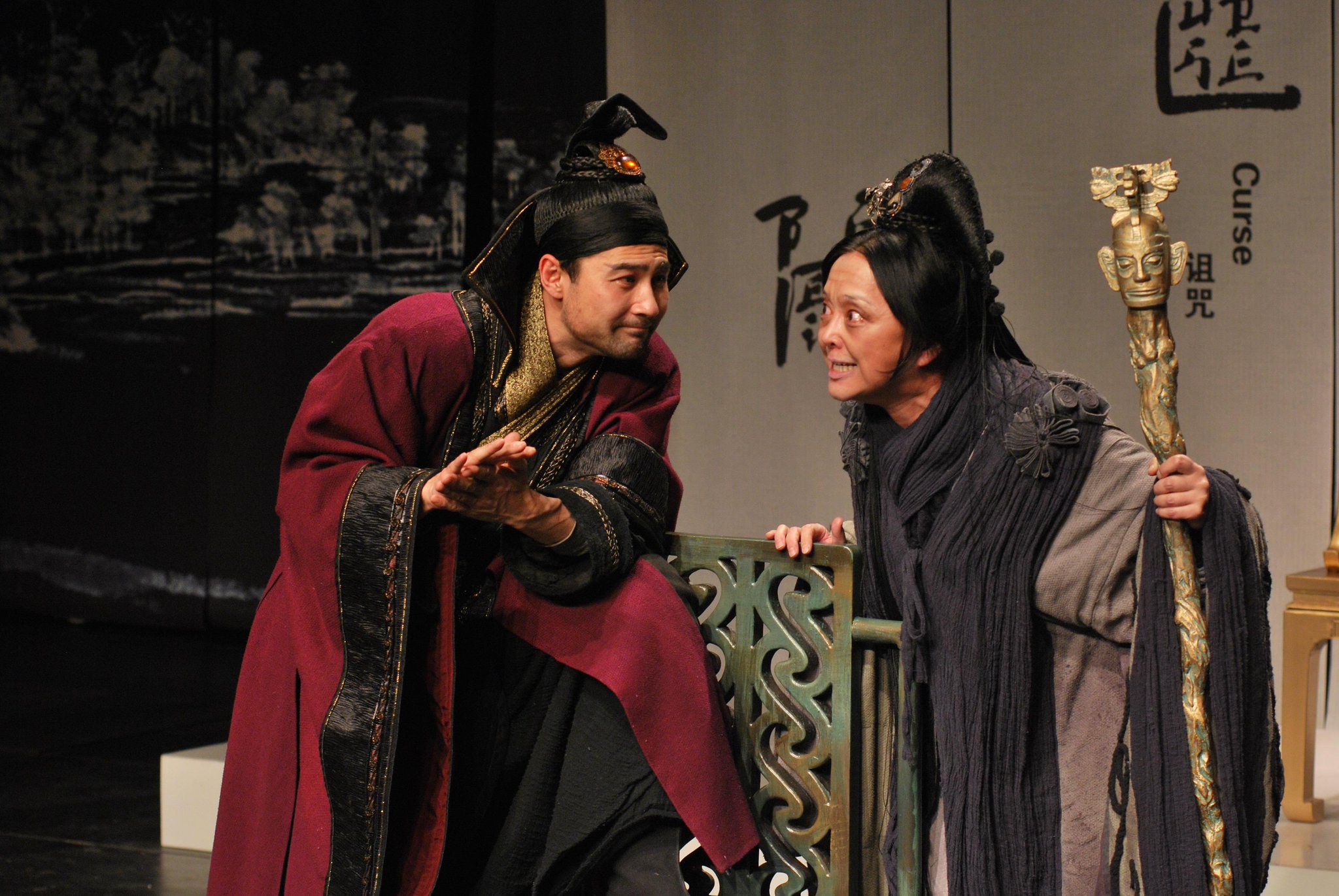
After seeing Shakespeare seen through the scope of an Italian composer, it didn't seem that far a step to see him filtered through the Chinese culture and language (in this case mandarin). This production is a pleasure to watch. Xiaoying has created a production that incorporates Chinese culture with Shakespeare's story and without the beauty of the text, you can see the pure talent on display. The murderers are played comically by Cai Jingchao and Zhang Zhiyong as a counterbalance to their acts whilst the murders are carried out with a black sheet being thrown over the victims head rather than in a goldfish bowl or being electrocuted. Wang Jianan extraordinary talent for drums help build up the tension as does the set from Luo Dajun that is showered with blood after each murder. The pure talent of Zhang Hao is astonishing to watch. His Richard rivals Mark Rylance's as a slippery a characterful portrayal that moves like a serpent waiting for it's next catch. Whilst the use of three witches at the beginning made me think that the Tang Shu-wing Theatre Studio had brought their production of Macbeth in early, it made for a fantastic afternoon of drama.
 |
|
On a damp and dark day, the dress rehearsal of Saul didn't give us a chance for the full Glyndebourne experience, instead letting the art take precedence. The dark day was totally overshadowed by the majesty and brightness of Handel's music and Barrie Kosky's production. From the first half, you can tell that this piece is an oratorio with the vast amount of God praising. Despite this, the production ranks as one of the most remarkable things I have seen in some time. It juggles minimalism with wealth and magnificence. It uses both poignancy and surrealist humour to create an overwhelming theatrical experience. Christopher Purves has acting talents that rival many of the great stage stars and his jealousy and rage created as a result of his hubris is felt stronger than any singer I have seen. Iestyn Davies is always a pleasure to listen to, with a voice that fills the large opera house with joy just as well as it does the intimate Sam Wannamaker Playhouse. Benjamin Hullet is creepy as a court jester type who embodies multiple roles in the same eerie costume whilst the women of the piece are wonderfully portrayed by Lucy Crowe and Sophie Bevan whilst Appleby portrays their brother Jonathan well, with only one misstep when a slightly homoerotic subtext is contrived between him and David in the only wrong step of a triumphant piece. A magnificent surprise opens the second half that triggered a spontaneous applause from the audience in a set design from Katrin Lea Tag that is awe inspiring and evokes the religious routes of Handel's music. It is the chorus, however, that really make this production something else.The Glyndebourne chorus create a sound that feels miraculous and the moments that they are alone on stage with the six dancers ( who do their job very well and add another dimension to an already impressive display) are the best moments of the show, and convey Handel's music in the best possible way. There are very few operatic productions that are perfect and whilst this isn't one of them, it comes very, very close.
 |
|
|
Shakespeare and opera seems to be the perfect combination to alienate people. The most feared playwright having his work produced in one of the most feared art forms surely must lead to a piece threatening and inaccessible. However, Carson's production is joyful and fun and provides a delightful evening of entertainment. Maestri's Falstaff is wonderful to watch, providing fun and laughter whilst the rest of the cast support the performance well, carrying off Verdi's complicated and fast melodies even if the vibrancy doesn't quite match that of Ambrogio Maestri. The set from Steinberg feels homely and fun even if the 1950s setting doesn't feel purposeful. I also wouldn't have understood the references to Deer horns if it wasn't for a very helpful Italian woman who explained their relevance as an Italian insult for a cheater. The times Shakespeare is translated almost word for word occasionally jarred with me, especially with the honour aria in Act One but this is no fault of the production. Overall, this is a refreshingly enjoyable evening that leaves you feeling light and refreshed.
 |
|
Apathy is the worst reaction you can have to any piece of art. If American Idiot the musical left me feeling angry, at least it would have been provocative. Instead, I faced two hours of a bland attempt at rebellion. Since seeing the musical, I have listened to the original Green Day album of the same title. Here, Billie Joe Armstrong's message is far clearer with a larger impact. What was an angry attack on post 9/11 society has become a story of an adolescent having mini tantrum. I've never been a fan of the Jukebox musical, seeing them as cheap and contrived. Therefore having the song '21 Guns' turned into Amelia Lily singing to stop the protagonist committing suicide, my heart sank. Luckily, I only saw the second preview so the creative team have time to iron out the dodgy lighting, sound and instruments as well as making sure that the company can sing in tune all the way through the musical. The advertisement putting Lily as top billing is blatantly misleading as she, along with every other female cast member, has almost nothing other than one or two solo spots and is solely there to have sex in a musical that is trying to be shown to be progressive and revolutionary (being given the prestigious name of 'whatsername' tells you all you need to know). It's a shame that the female members of the company are underused as they have much better voices and pronunciation than the men of whom I could barely make out a word that they sung. Racky Plews' direction and choreography doesn't help by glorifying heavy drug use that is never resolved or questioned. That on top of the theatre not having any air con and keeping the doors shut until 2.25 for a 2.30 start led to perhaps one of the worst theatrical experiences I have ever had.
The Temporary theatre provides the National with pieces that are often experimental and slightly odd. Therefore Tim Crouch's experiment naturally fits in this space. The concept is that Tim performs this play with an actor who has neither read nor seen the play before stepping on the stage. For the last night, Samuel West was this actor who played the Father. This play really helps to show West's talent that he can communicate deep emotions of loss and pain when he is repeating words as he hears them through his headphones. Crouch smoothed the process over as much as he can but you still leave slightly unsatisfied with the performance as a piece of art. Despite this, this concept of the hypnotist as a manipulator and how that relates to both the play and the exercise is fascinating. The play itself could be transformed into a fantastic piece but is diluted too much by the gimmick and classroom exercise feel.


