 |
|
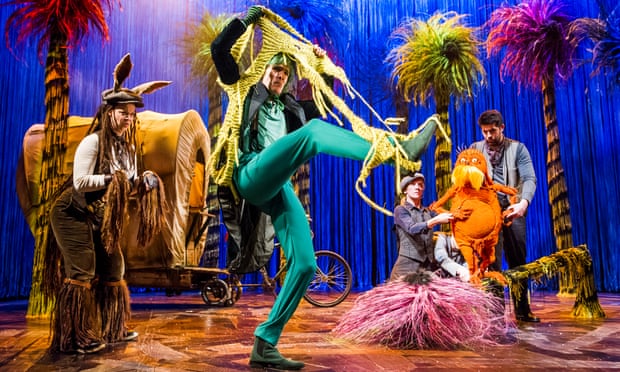
The issue of global warming is addressed in David Greig's adaptation of Dr Seuss's famous story. The show tells the story of the Once-ler and how his obsession with making money destroys the Lorax's paradise. Through puppetry, the Lorax is brought to life with exceptional skill which always astonishes me. From the Lion King to Avenue Q and now to this, how the skill of the puppeteers manage to give this inanimate object a life and personality of it's own is unimaginable. The story occasionally can feel the wrong side of preachy but this rarely happens and is a laugh right the way through. From jokes about the rhyming, which never gets tiresome, to music from Charlie Fink which is fun and jaunty, it's a brilliant family show. Rob Howell's set is colourful and captures your imagination with wonderful quirks like the trees and Once-ler tower. Simon Paisley- Day is a great Once-ler, emboying the problem of capitalism in a fun and jovial, turning sinister Once-ley whilst Simon Lipkin provides the Lorax with an animated and characterful voice which is a delight to watch. It's hard not to fall in love with a show so excellently crafted as this one.
 |
|
I came in to the Young Vic feeling apprehensive. Their previous Shakespeare was less than entertaining and this was another proscenium arch production in a space which is clearly best suited to thrust and in-the-round productions. However, as I started I instantly felt comfortable that Carrie Cracknell and Lucy Guerin knew what they were doing. This Macbeth combines the text with superb choreography which intensifies the supernatural elements of the drama. Ana Beatriz Meireles, Jessie Oshodi and Clemmie Sveaas especially are wonderfully unsettling and physical as the three witches who, in this production, appear to manipulate Macbeth's descent into madness rather than being done by Macbeth's own greed and ambition, shown through their almost continuous presence in the drama. Lizzie Clachan's design also demonstrates Macbeth's fate being pre-determined and his being trapped in yet another striking and ingenious design from Clachan, who is demonstrating the huge talent of designers in modern theatre that is staggering in quality. Neil Austin too has become the go-too guy for great lighting design and he excels here, both concealing the truth and, especially in the banquet scene, contrasts between Macbeth's mind and the action. Performances are immense. Anna Maxwell Martin is a formidable Lady M, not falling into the villainess trap, with her silences meaning as much as her words, which are conveyed with passion and elegance. John Heffernan is quickly turning into my favourite actor with an incomparable gift for maintaining a rhythm and technique whilst portraying pure truth. In Oppenheimer, his performance rescued what, in my opinion, was a flawed production. Here, his talent is allowed to blend in and fuse with perhas the strongest ensemble I've seen this year. Prasanna Puwanarajah also wonderful as Banquo and the casting of his son Fleance is thought provoking and an inspired directorial decision. This is one of the shows of the year and shows that the Young Vic haven't lost their ability to punch above the heavy weights with this gem of a tragedy. (Genuinely awful programmes though. Even worse than the Dorfman one. One tiny article and some biographies simply isn't good enough for three pounds!)
Calixto Bieito has returned to the English National Opera to direct Verdi's truly epic opera of love and war. The scale of the piece ranges from the personal to the large scale war scenes which leaves quite an impact on the audience. Wigglesworth's interpretation of Verdi's score, as with Lady Macbeth, is dramatic, grand and rich. The overture is just wonderful to listen to. The singing too is world-class. Tamara Wilson is a revelation as Leonora whilst Gwyn Hughes Jones' Don Alvaro is also well constructed and strong. The piece could be stronger with a less ambiguous set design from Rebecca Ringst whose use of videos is not helpful to either plot or meaning whilst Bieito isn't always clear in showing the audience what is going on. This detracts somewhat from what is otherwise an evening showcasing extraordinary talent.
Jonathan Miller's production of the Barber of Seville has aged badly but the same can't be said for his production of Gilbert and Sullivan's Mikado. Thanks to Stefanos Lazaridis' set design and Sue Blane's costumes, this production is bright and vibrant, keeping the light- hearted humour of G and S without falling into the more racist, stereotypical pitfalls of the jokes. Carol Grant and Anthony von Laast's choreography is delightful and comic whilst Marc Rosette's and Davy Cunningham's lighting makes the production look joyous. Richard Suart is wonderfully kniving and sympathetic Ko-Ko, with a brilliantly topical little list including pig-gate and Top Gear and Anthony Gregory as Nanki- Poo is vocally excellent as well as comical. Mary Bevan's Yum-Yum feels effortless as does every performance in this cast. This is truly Gilbert and Sullivan at it's most fun.
 |
|
My first two visits to Glyndebourne this year were two of the best experiences one could wish for. You make an effort to get to an inaccessible place to watch a supposed inaccessible art form and you appreciate it all the more for that. Your day is sacrificed in order to watch and experience a group of people, an organisation, strive for perfection in a way that you rarely see in London. This perhaps is why I took so easily to David Hare's play about Glyndebourne's conception at the Hampstead Theatre. It is a celebration of striving for excellence; the singleminded, ambitious aims of John Christie and the importance of art at it's purest. Hare manages to create a narrative of Glyndebourne's early years whilst jumping about different time gaps which in so many cases is frustrating but here goes unnoticed. It is a riveting play which keeps you hooked for the duration. Rae Smith has designed a set which shows the construction of beauty with an unfinished oil painting of the organ room with a stage being surrounded by tables and paintings off stage for action that isn't about Glyndebourne itself which Jeremy Herrin stages ingeniously. Roger Allam is, as ever, delightful to watch as the headstrong yet personable John Christie whilst Nancy Carroll is quiet yet forceful as his wife Audrey Mildmay. George Taylor, Paul Jesson and Nick Sampson are wonderful as the team who come to turn Christie's dream into reality. There is one speech which Roger Allam performs spectacularly well addressing the price of art, saying that people need to invest in the art they see 'and if it takes a whole day and wipes out their savings, so much the better'. Whilst this argument is strong, it is an argument I fundamentally disagree with. Art does require investment but if that means that a whole section of society can't access that art, that art form becomes elitist and exclusive which is disturbing to me. It is therefore to the plays credit that I came out of this play pleased, despite this speech, and this comes down to the talent of the cast and creative team.
 |
|
The bravery of Kate Mulvany and Anne-Louise Sarks' adaptation of Medea to put the children at the forefront is commendable. The practicalities of getting strong enough child actors to star is near impossible, on top of the need to get across Euripides' original plot and essentially make two children waiting feel exiting and engaging for one hour and ten minutes. Therefore it is astonishing to find that Sarks' production not only works; it excels in every aspect. The setting both exists in the modern day, with Amy Jane Cook's design transforming the Gate's space into a contemporary boys bedroom, and in the Greek age, with the story of Jason and the Argonauts being recounted which could either be interpreted as a fairytale or a real one. The language is naturalistic and focuses on the children's innocence but also treats Medea with sympathy. Amongst the innocence, however, it also has a social commentary on modern day socialisation. You enter in to a normal boy's bedroom strewn about with Nerf guns, bows and arrows and, throughout the show, Jasper and Leon fence, reenact deaths and attack a toy monkey with a foam baseball bat. These activities are used to demonstrate the socialisation of males towards violence and aggression in a rather unsettling way. This feeling is intensified when it is being carried out by innocent children who still wet themselves and hug their father's blanket. Jasper and Leon were played by Bill Keogh and Samuel Menhinick at the performance I went to and they are wonderful young actors who don't come across as precocious and annoying which child actors occasionally come across as. This is a wonderfully immersive and emotional experience that gets to the crux of Euripide's tragedy.
Emily Bronte's classic novel has been given a radical makeover in Stephanie Street's new adaptation in a production from the National Youth Theatre. Street's narrative arc in this adaptation feels both uneventful (which is often a problem in stage versions of novels) and rushed in an attempt to fit about 350 pages of story into under 2 hours of material. Scenes between older Kathy and Heathcliffe appear to have no particular purpose other than to reminisce and argue whilst alternating younger Heathcliffe and Kathy seems to only be done in order for all of the company to have a part. Cecillia Carey's set design manages to maintain the gothic nature of the novel whilst making it feel updated and modern and the ensemble cast give admirable performances. However, these upsides don't stop this evening from feeling unsatisfying and unfinished.
George Friedrich Haas' new opera has had it's premiere at the Royal Opera House and it has fallen into a problem many directors find in the space. This opera, an intimate piece about life and death, feels lost in the 2000 seat venue. The music is a sweeping soundscape which at times is chilling and emotionally led yet it could be scaled down to fit in a studio space. Graham Vick's staging would also adapt better in the Linbury but minimalism doesn't work well in a space where small expressions are lost by the 6th or 7th row back. The amplification of speech also loses some emotionally intensity, despite Klaus Maria Brandauer's best efforts. Performances from the singers are competent but not as emotionally rich as one might wish for in a piece about death. The piece finished with two thirds of the audience still there which is some achievement yet I don't think it has succeeded in bringing anything particularly powerful to the stage.


