|
|
One of the most depressing things to see at any theatre production is to be in a half- empty performance. Therefore, it was disheartening to see Edward Gardner's last production as music director being played to a visibly empty coliseum. However, my spirits were quickly lifted by a sublime performance. The leads are some of the best performances I've seen. Hoare's Hermann captures both the characters devotion to Lisa and the addiction that eventually tears him away, although I found it hard to believe that Giselle Adam's Lisa would be prepared to risk her reputation for the love of a visibly damaged and disheveled human being portrayed by Peter Hoare. The night, however, belongs to Felicity Palmer who is utterly magnificent, hypnotic and any other superlatives you can think of. It is one of those historic performances that will live long in the memory. Her voice is so rich and powerful that it is impossible not to fall in love with it. Gardner brings out the rich emotion in Tchaikovsky's score and is well played by the orchestra. The chorus is also brilliant, as always. Alden's direction and Davey's designs provide some striking images and is an effective way of communicating the story. However, there are parts which seem to have been added purely as gimmicks in the hope of giving the production a strong identity which is unfortunate. Specifically, the use of animal heads and 'onesies' seems to have no other purpose than to give the audience something to remember. Despite this, I felt that this production was extremely successful due to the mighty Felicity Palmer that really steals the show.
 |
|
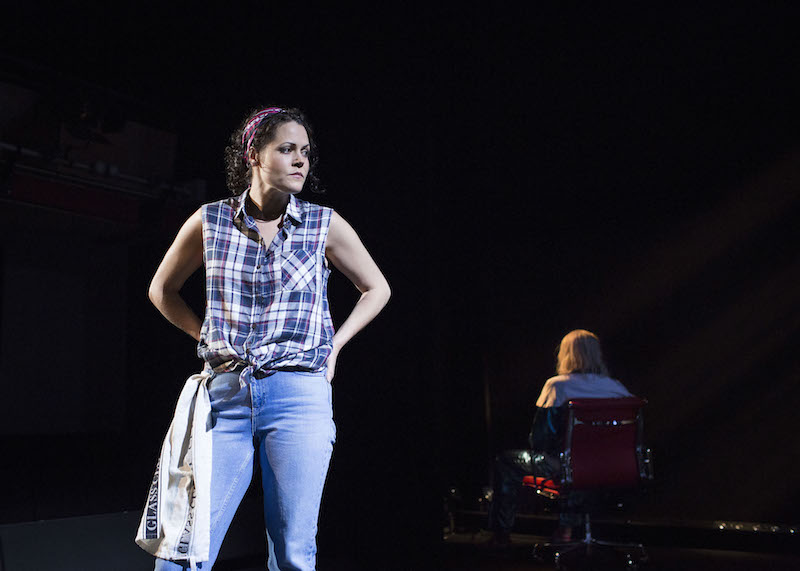
What on earth did I just see?!! This new piece at the Temporary Theatre couldn't be more different to the last piece; a subdue and subtle show on zero hours contracts. This production is far from subtle, dealing with pornography like a sledgehammer to the face. It is safe to say that RashDash artistic directors and performers Helen Goalen and Abbie Greenland are pretty anti porn. They convey this message pretty strongly through a series of sketches featuring the pair and one of the ensemble cast in situations ranging from tying up the queen to shooting a teenager. Some parts are pretty abstract whilst others are more direct. It is certainly different, even if it isn't too much else. The most thought provoking moment in it comes at the beginning and the rest is made up almost entirely of sequences milked for every last drop of meaning or laughs, whatever the audience wants to take it as. It also features cans of "Value Sex" which is brought on at certain points which I think is supposed to mean something but can't quite work out what. The general gist is sex is good, porn is bad. If you want to hear that message told with loud music, a dancing queen and exhausting dance, this is the play for you. If not, you could find yourself in for a very tiring and confusing evening.
 |
|
The Jerwood Theatre Upstairs is such an exiting space to walk into. You never know what form it will take. It can transform from a typical raked seating to a classroom to a grimy room with weathered deck chairs and decaying walls. The play itself is quite remarkable. It's disturbing, devastating yet also tremendously funny at times. It is certainly the most wholesome play to come out of the Royal Court in the past year if not the best. Owen's script messes with your head and takes you to dark places. The plot twists in unexpected ways and uses characters which scare you. Hamish Pirie's direction shows an understanding of how to play in the round in a way that many directors don't have. He maintains the intimacy it brings whilst not neglecting part of the audience in the process. He also encourages some of the most remarkably naturalistic performances from all four members of the cast. David Moorst's Liam is inspired, showing a subtly estranged performance and keeps the character real as the plot takes you to darker places. All four members of this wonderful production deserves an award for their complex and frightening portrayals. Jason Hughes' 'violence' is played in a way that the audience's sympathy for him and the other characters fluctuate for the duration. This is the Royal Court packing a punch to the gut leaving me shocked and profoundly moved.
 |
|
I'm not overly sure what to think of this production. I saw the second preview, the afternoon before press-night in a noticeably less than full auditorium. I didn't feel like a play dramatising this subject was unwise or too soon to be done but felt that it needed to be executed perfectly and come from an original perspective to carry off this huge feat. It is safe to say that this production doesn't quite achieve that. It tells the story of Savile through two separate narratives. The first a TV show in the style of This is your life which takes us through the work of Savile whilst the other follows a fictional character called Lucy, a victim of Savile, who is seeking for justice. I love Brendan O'Hea's acting work at the Globe but find his direction doesn't capture the drama or atrocities so that a striking play just feels surprisingly bland. Maitland's script sheds no new perspective on the case and seems slightly formulaic at times. Even McGowan's Savile occasionally felt like he was doing an imitation. However, at other times, his does capture the complexities and the menace of the man, especially in the final scenes. .Leah Whitaker's Lucy is fantastically played, showing the grief, anger and terror of Savile's crimes. It is played sensitively yet doesn't let that comprimise the piece. The other actors make the most of what are quite poorly written and developed characters who help the audience try to comprehend how these disturbing acts were covered up. I admire the brave and courageous programming from the Park theatre to have shown a play this daring, I think that this needed more time for a better script to be written and for a better produced piece to be formed.
 |
|
As I always confess when talking about concerts is that I know nothing about music. Despite this, you couldn't help but adore the sublime array of pieces at this world premiere of Muhly's meditation about Alan Turing. The first half consisted of Dowland's If my complaints could passions move, Brittens reflection on the piece with Lachrymae, and Vicaldi's Stabat mater, which looks at Mary's grief at the Passion of Christ. The Dowland is wonderfully conflicting with both melancholy and joy evoked. It is rare, even for me, to cry at the first piece, yet Davies' voice is so exquisite that my eyes began to water towards the end. Whilst I could not see the similarities in the following piece, Britten's Lachrymae is nonetheless an astonishing composition astonishingly performed by the sinfonia with Lawrence Power giving a masterclass in the viola. The years of jokes this man must have had to endure was worth it to see the precision and extraordinary skill present to perform what must be a hellish piece to perform at times. The highlight of the first half was, without a shadow of a doubt, Vivldi's Stabat mater. The baroque piece captures the pain and anguish felt by someone for the loss of a loved one and is,for my money,one of the best pieces of art around to capture this story. The tierce de picardie at the end hints at the hope of the resurrection whilst Iestyn Davies sings this melody that conveys the utter despair of Christ's mother whilst maintaining grace, elegance and beauty. This neatly links to the main attraction and to the organist's very own composition. Both Stabat mater and Sentences use the grief and love of the mother as a vehicle to explore different things. In Sentences, this is used to explore the life of Alan Turing. This composition is so many things. It is clever without being gimmicky or arrogant. At times it is rather amusing yet isn't at all facetious. It is heartbreaking yet not sentimental. This relies on four factors that need to be spot on. First, and most importantly, Muhly's score is the closest that contemporary music has come to perfection. He doesn't underestimate the power of melody whilst also creating an edge to the piece through interesting uses of percussion (eg. typewriters and knitting needles). Secondly, the librettist Adam Gopnick is wonderful at both providing a coherent story and helps to provide the suppressed feeling that is released through the music. Davies is also astonishing, providing hearty performance, showing both the hurt and the joy of Turing and lastly, the sinfonia's accompaniment is rich and heart felt. The evening was an utter delight and pleasure.
 |
|
To me, Renaissance Comedy seems the biggest oxymoron imaginable. Theatre companies often deflect to slapstick to bleed some humour out of a largely humourless text. However, there is no other way to describe the experience of the National's Beaux Stratagem than as thoroughly entertaining. Samuel Barnett, Geoffrey Streatfield lead a wonderful cast as the Beaux who search to retain their post wealth by marrying rich women, portrayed delightfully by Susannah Fielding and Pippa Bennett- Warner. These roles are played extremely well and doesn't feel overplayed. This is true to the whole production. It looks to the text for humour rather than masking it with something that seems artificial. Lizzie Clachan's set is quite simple yet beautiful and gives the Olivier an unaturaly homely and comfortable feeling, in stark contrast from normal programming in this space. Pierce Quigley, as always, is eye wateringly funny as the servant Scrub in a dry and unexploited presentation of this well written role. This toned down production is thanks to Godwin's great direction whilst Michael Bruce provides some perfect music and songs to set this quaint atmosphere. The programme also notes as Patrick Marber assisting Godwin with the dramaturgy. I still have no idea what a dramaturg is but I'm sure he did a very good job at it. The play is not the typical Restoration Comedy which does both the cast and the audience a service in providing a great comedic and intelligent event.
 |
|
Rufus Norris has officially arrived with his first play as Artistic Director of the National. In this, Norris sends us a fresh reminder of our responsibility for each other with an adaptation by Carol Ann Duffy of the famous morality play. Her adaptation is mostly successful and, whilst her references to modern culture is often misjudged and awkward (like a grandparent saying 'word up to ma mandem'), when she writes on the bigger picture on subjects such as God and mortality, the text feels as juicy as Shakespeare. In a this production, Everyman is a high flying businessman who likes to enjoy himself with sex, drugs and drink. The cocaine scene feels very theatrical and doesn't have the gritty effect it should have perhaps due to De Frutos' wonderful yet stylized movement that perhaps holds back the message from getting across to the audience. Despite this, the scenes that have a large scale like the party or the storm provides a great atmosphere to the Olivier and, whilst the more intimate scenes feel lost in the space, the whole piece still maintains the power. Chiwetel Ejiofor gives an exhausting yet fantastic portrayal of Everyman and is backed by a terrific ensemble. I am not totally convinced by this flawed production but it still packs a punch which is impressive to see.
 |
|
The Twits is the latest of Dahl adaptions to reach London. Currently on the West End, both Charlie and the Chocolate Factory as well as Matilda are continuing to entertain and astonish crowds. There have also been adaptions of shows like Danny Champion of the World. This is perhaps due to the fact that the surreal writing of the genius and his heightened characters are at home on the stage. However, when I saw that The Twits was coming to the Royal Court, I was slightly surprised. Not that the characters wouldn't suit the stage; Mr and Mrs Twit are so strange and weird that would be instant hits on a stage; rather that the story-line of the novella is hardly complex. In fact there is no real story-line as such. Unless the Royal Court wanted to do a Beckett interpretation of Roald Dahl's classic, it would be difficult to translate the plot, or lack thereof, and to keep children entertained for two hours. What Enda Walsh has done is to pad out the story and introduces us to three new characters who are seeking to have their fairground returned after Mr and Mrs Twit 'stole' it from them. This addition works but the Dahl surrealism is lost. I hate to say it, but I feel that Enda Walsh needs to be more mischievous in his adaptation. It occasionally feels slightly tame in spite of Monica Dolan and Jason Watkins being far from tame in the title roles. They are magnificently horrible conveying the metaphor of the posh suppressing the lower classes well for the adults who get something out of the evening as well as the kids. The monkey's are good, as are the new additions but there is a love interest subplot between a monkey and the waltzer boy which seems slightly problematic. Is this the perfect adaptation of a Dahl book? Not by a long shot but it is a pretty good stab at one and results in an experience which is extremely pleasant.